

Dear NEAHQ Members and Friends,
As we welcome spring, I’m energized by the momentum building across our community at the New England Association of Healthcare Quality (NEAHQ) and by the shared commitment we continue to show toward advancing healthcare quality, equity, and patient-centered outcomes.
This season brings a renewed focus on some of the most important quality priorities shaping our work today, strengthening patient safety and reliability, advancing health equity and data-driven decision making, preparing for evolving regulatory expectations, and using innovation and digital tools to improve care delivery and member experience. Across New England and beyond, quality professionals are leading meaningful changes, and NEAHQ remains committed to supporting you with education, connection, and opportunities to learn from one another.
Spring is also a time of growth—and with that comes an exciting opportunity to get more involved in NEAHQ leadership.
If you are passionate about advancing quality, supporting your peers, and helping NEAHQ continue to grow as a trusted professional home, I strongly encourage you to apply or nominate a colleague, to become a NEAHQ Board Director. Let’s work together!
Be sure to check out our upcoming NEAHQ events and programs here and join us for opportunities to learn, connect, and grow: https://www.neahq.org/events
Thank you for your continued engagement, leadership, and dedication to improving healthcare quality. I look forward to an inspiring and impactful spring season with our NEAHQ community.
Warm regards,
Sabrina Zerzouri
President, NEAHQ
Interested in becoming a NEAHQ Director?
The NEAHQ nominating team is seeking applications for the 2026 - 2027 Board of Directors ballot that will be presented to the membership for a vote in May 2026.
Becoming a part of the NEAHQ leadership gives you the opportunity to help shape the future of the organization and healthcare quality. Board leaders are responsible for:
- Guiding the association
- Anticipating change in the quality environment
- Addressing the interests and needs of members
The candidate positions available include:
President-elect is a three (3) year commitment, serving a year as President-Elect, a year as President and a year as Past- President.
Directors serve for a one-year term, act as a representative of the healthcare quality professional community, serve as an ambassador for stakeholder and community relations and work with Board to carry out its responsibilities. They actively participate in the work of the organization, such as programs.
Treasurer serves for a two-year term, pays the bills and maintains the financial records of the association.
Please contact Lynn Myers at 781-308-0501 or myerslynn225@gmail.com to discuss the various positions or complete an application.
NEAHQ and our affiliated partner associations, as part of the multi-state Healthcare Quality Association Collective, have several great programs scheduled this spring. Some programs are free for NEAHQ members, while others are discounted. Visit our Events Calendar to connect to registration information for each of these programs or navigate through the links below. Thank you for your continued support and participation.
- OAHQ presents Quality Strategic Priorities & Strategy Deployment on 22 Apr 2026 12:00pm-1:00pm EDT
- AzAHQ presents Spring Virtual Conference Quality’s Role in Organizational Culture on 30 Apr 2026 11:00am - 7:30pm EDT
- OAHQ presents Large-Scale Improvement Efforts and a Culture of Improvement on 12 May 2026 12:00pm - 1:00pm EDT
- OrAHQ presents Ethics and Compliance of AI Use in Healthcare Part 3 on 20 May 2026 3:00pm - 4:30pm EDT
- NEAHQ presents Advancing Health Equity: Data-Driven Strategies to Reduce Disparities on 22 May 2026 1:00pm-2:00pm EDT
- AzAHQ presents The Quality Journey Spring 2026 on 29 May 2026 11:00am-3:00pm EDT
- NCAHQ presents Breaking Healthcare Silos: Incorporating Quality and Safety into Compliance Programs on 02 Jun 2026 12:00pm - 1:00pm EDT
Share Your Expertise
Interested in presenting at one of our upcoming webinars? We invite members to share their knowledge and experience with our audience. Speaking is a great way to contribute to the community while building your profile and thought leadership. To express interest, simply email us at admin@neahq.org.
January 2026
NEAHQ currently has $42,723.96 in total assets as of the end of January 2026. Total revenue generated in 2026 YTD (January 2026) is $282.25. NEAHQ generated $215.67 in revenue from membership dues while $66.58 came from program. Total expenditures for 2026 YTD (January) were $169.89. Total expenditure was made up of operating expenses.
2025 Calendar Year Report
NEAHQ ended 2025 with $42,611.60 in total assets as of the end of December 2025. Total revenue generated in 2025 YTD (Jan-Dec) is $6,890.12. NEAHQ generated $6490.64 in revenue from membership dues while $399.48 came from program. Refund $158.00 Total expenditures for 2025 YTD (Jan-Dec) were $4,567.81. Total expenditure was made up of administrative, operating and CEU expenses.

Would you please share a brief overview of your career?
I love the career I’ve been lucky enough to have! I started at Tufts Medical Center as a student nurse in 1994. I hoped at that time that I had “my foot in the door” and I’d be able to continue working there after graduating from Saint Anselm College. That was during a time when there weren’t many nursing jobs available, but I was lucky enough to get offered a nursing position on a surgical floor. There, I built my nursing foundation and made lifelong friends. My first year was tumultuous as there were layoffs which I survived. Towards the end of my first year, I transferred to the Surgical ICU where I spent the next 15 years. At that point in time, I was looking for a change, a new challenge. The educator role had been vacant for 2 years, so I made the leap. The role transitioned from educator to Professional Development Manager, to Professional Development Director over time. Initially focusing entirely on critical care, over these next 15 years I took on a broader role expanding beyond critical care. I became the nursing liaison for Supply Chain, Public Safety, Emergency Management, and Quality. I eventually joined the Quality & Patient Safety Department in a more formal role as Senior Director for Quality Performance & Value-Based Care, where I hope to spend my final 15 years as a nurse.
Which aspect of your current position is especially rewarding?
What I find most rewarding in my role is knowing that the work we do behind the scenes directly impacts the safety and experience of our patients and families. Much of the effort is proactive, strengthening processes, preventing harm, and improving reliability. While that work isn’t always visible, it truly matters.
I’ve had the privilege of working alongside dedicated professionals for 30 years here at Tufts. Helping to create an environment where those clinicians thrive in an environment where safety is prioritized, communication is open, and performance improvement is continuous. When I see teams confidently navigate a survey, implement a safety initiative, or prevent harm because of systems we’ve strengthened, I feel proud of this collective work.
Has any one individual greatly influenced to your career?
One individual who has profoundly influenced my career was my nurse manager early on in my time at Tufts Medical Center. I was a relatively new med/surg nurse when I expressed interest in transferring to critical care, at a time when that kind of move, with so little experience, was virtually unheard of.
She was willing to look beyond tenure and focus on my capability and potential. Her decision to support my transfer was transformative. It accelerated my clinical growth and ultimately shaped my entire professional journey. More importantly, she modeled what it means to be a leader who invests in people, not just when it’s easy, but when it requires courage and advocacy. That experience has influenced how I approach leadership today and challenges faced.
What led to your involvement with NEAHQ?
Lynn Myers approached me soon after she finished precepting me into my new role (of course we brought her out of retirement to do this). I recognize that quality and patient safety along with regulatory measures and value-based care requires a different skill set. NEAHQ offers exposure to best practices and regulatory updates, as well as a community to gain further knowledge from. As healthcare evolves, I want to stay connected to broader expertise and emerging best practices. We all face similar challenges and engaging with colleagues across New England provides perspective, shared learning, and opportunities to bring innovative ideas back to my own organization.
What are your goals as a NEAHQ Board Member?
As a board member of NEAHQ, my goal is to ultimately mentor and facilitate growth of new quality leaders, contribute to education and professional development, and ensure programming equips members with strategies they can apply in their own organizations. A strong professional community where quality leaders can learn from one another and grow together will only strengthen us as quality leaders.
How do you balance your demanding professional life with your personal life?
Balancing a demanding professional life with my personal life starts with clarity about what matters most to me. I have an elderly mother, and my sister cares for her full time. Outside of work, I prioritize spending time with them and being present in whatever way I can. That time keeps me grounded and reminds me what truly matters. I’ve also learned to find joy in small, everyday moments, such as quiet routines, simple time together, and the predictability of structure. I’m someone who appreciates routine, it creates stability and helps me manage the intensity that can come with leadership in healthcare. Work is important and meaningful to me, but it’s not everything. Being intentional about where I place my time and energy allows me to show up fully in both spaces.
Swim lanes are a process-mapping and performance visualization tool used to improve cross-functional workflows by clearly showing who does what, when, and how work moves between roles or teams. Each lane represents a person, department, or system involved in a process.
In healthcare, swim lanes are commonly used in quality improvement, process redesign, and patient-flow initiatives to visualize complex clinical and administrative workflows that span multiple departments. By mapping the end-to-end process from the patient’s perspective (for example, admission to discharge), swim lanes make it easier to identify delays, communication gaps, inefficiencies, risks, and unclear responsibilities—especially in processes involving multiple teams such as hospital discharge.
Example: Improving Hospital Discharge Process
Scenario: A hospital wanted to reduce delays in its discharge process, which was taking too long and causing bed shortages.
Approach: A cross-functional team mapped the discharge process using a swimlane diagram:
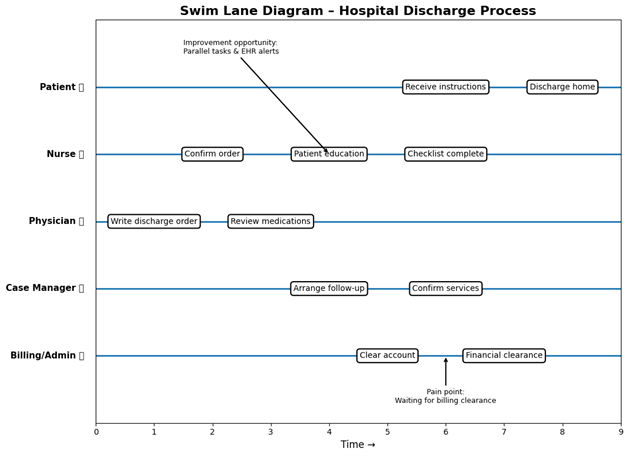
Figure. Swim Lane Diagram of a Hospital Discharge Process
This swim lane diagram illustrates how discharge activities move over time across patients, nurses, physicians, case managers, and billing staff. By separating tasks by role, the diagram clearly shows pain points (e.g., billing delays, sequential tasks, and unclear handoffs) and opportunities for improvement, such as EHR triggers, parallel work, and clearer role accountability.
The NEAHQ Blog features frequent posts from healthcare quality professionals on topics that range from emerging healthcare trends, new legislation, real-world application of PI principles, and much more! Recent blog posts have discussed the use of AI in healthcare, changes to the Joint Commission’s survey process, and how to apply the HRO principle of Commitment to Resilience. Check out the blog here.
Institute for Healthcare Improvement: Getting Involved with the Partnership for Quality Improvement
IHI is looking for your input! The Partnership for Quality Measurement (PQM), managed by Battelle, is responsible for reviewing and endorsing health care quality measures for adoption, ensuring they are relevant, unbiased, and practical for improving patient outcomes. IHI has supported this effort since 2023, partnering with Battelle to bring quality improvement expertise and an equity lens to this important process.
Through PQM, individuals can participate in important conversations and influence decisions that impact care across the country. There are three distinct review processes that individuals can join, with a range of engagement opportunities – from sharing public comments to taking an active role as a committee member. Each process plays a critical role in ensuring that quality measures are evidence-based, practical, and aligned with the needs of the health care system.
The Endorsement & Maintenance (E&M) process ensures measures submitted for endorsement are evidence-based, scientifically sound, and aligned with current professional knowledge. Measures must be safe and effective and must not increase the risk of unintended adverse outcomes. Each E&M cycle, held in the fall and spring, involves thorough review by an E&M committee, which decides whether to endorse each measure. In 2025, 92 measures were submitted to Battelle for consideration, of which 59 advanced to committee review. These measures address critical areas like patient safety, clinical effectiveness, health access, and cost reduction.
The Pre-Rule-Making Measure Review (PRMR) process occurs annually to provide recommendations to the Department of Health and Human Services (HHS) Centers for Medicare & Medicaid Services (CMS) on the selection of quality and efficiency measures under consideration for use by HHS. PRMR evaluates measures based on meaningfulness, appropriateness of scale, and time to value realization. In 2025, the committee provided recommendations on 52 measures.
The Measure Set Review (MSR) process is also conducted yearly to assess whether measures should remain in CMS programs. The MSR committee evaluates measures across three key domains: meaningfulness, data stream parsimony, and patient journey. In 2025, the MSR Recommendation Group reviewed 21 measures across six CMS programs.
PQM membership is free, which encourages broad participation and ensures that all perspectives are represented. Anyone interested in quality measurement can get involved at a level that works for them:
- Join PQM: Sign up for free with your name, position, and email. Organizational memberships are also available. Members receive newsletters with updates and engagement opportunities throughout the year.
- Add public comments: Share your feedback on proposed measures, process enhancements, committee lists, and recommendations. View all open and closed comment opportunities here.
- Join a committee: Contribute your expertise to one of PQM’s three measure review processes. Committees are formed to reflect diverse perspectives, and membership is reviewed annually.
If you have a passion for quality measurement but you’re not sure where to start, the Battelle team is happy to provide guidance: PQMSupport@battelle.org.
Learn more here.
ECRI Top 10 Patient Safety Concerns for 2026
ECRI has announced their new list of top 10 Patient Safety Concerns for 2026:
1. Navigating the AI Diagnostic Dilemma
2. Reduced Access to Rural Healthcare Increases Health Risks and Disparities
3. Increasing Rates of Preventable Acute Diseases in Communities and Healthcare Settings
4. Effects of Federal Funding Cuts on Healthcare Operations and Patient Safety
5. Lack of Recognition and Reporting of Harm Events
6. Structural and Systemic Barriers Inhibit Equitable Pain Management for Women
7. Persistent Workforce Shortages Continue to Burden Staff and Restrict Access to Care
8. The Impact on System Improvement When a Culture of Blame Hinders Learning
9. Emergency Department Boarding Contributes to Worse Patient Outcomes
10. Persistent Gaps in Manufacturer Packaging and Labeling Design Continue to Undermine Medication Safety Efforts
Learn more here.